12 Best Sales Engagement Platforms for 2025
November 29, 2025
Finding the right sales engagement platform is crucial for building a predictable, scalable revenue engine. With dozens of options available, each promising to streamline outreach and boost productivity, it’s easy to get lost in feature comparisons and marketing jargon. This guide cuts through the noise to provide a clear, comprehensive analysis of the best sales engagement platforms for different business needs.
This resource is designed for sales leaders, founders, and revenue teams who need to make an informed decision without wading through countless demo calls. We'll dissect the top tools on the market, from enterprise-grade titans like Salesloft and Outreach to versatile SMB solutions like Apollo.io and Mailshake. Our goal is to move beyond generic feature lists and offer a practical evaluation of what it's truly like to use these platforms day-to-day.
Throughout this guide, you will find:
- Detailed breakdowns of each platform’s core features, from sequencing and dialers to analytics and AI capabilities.
- Honest pros and cons based on real user experiences and implementation challenges.
- Specific use-case scenarios to help you visualize how each tool fits into your existing sales workflow.
- Clear pricing information and analysis of who each platform is truly built for, whether you're a lean startup, a growing SMB, or a complex enterprise.
- Direct links and screenshots for every platform, allowing you to see the interface and explore further with ease.
We will also compare these solutions to Roger, clarifying its unique position in the market and helping you determine if it's the right choice for your team. By the end, you'll have a robust framework to confidently select the best sales engagement platform to accelerate your pipeline and close more deals. Let's dive in.
1. Roger
Best For | Fully automated, AI-powered outbound prospecting
Roger stands out as one of the best sales engagement platforms by offering a truly end-to-end, AI-powered automation solution that essentially functions as a digital Sales Development Representative (SDR). Where most platforms provide tools to help your team execute outreach, Roger takes over the entire process from lead discovery to meeting booking. Users define their Ideal Customer Profile (ICP) and approve initial messaging, and Roger handles the rest: continuously finding qualified leads, verifying contact data, and executing personalized, multi-channel outreach sequences across email and LinkedIn.
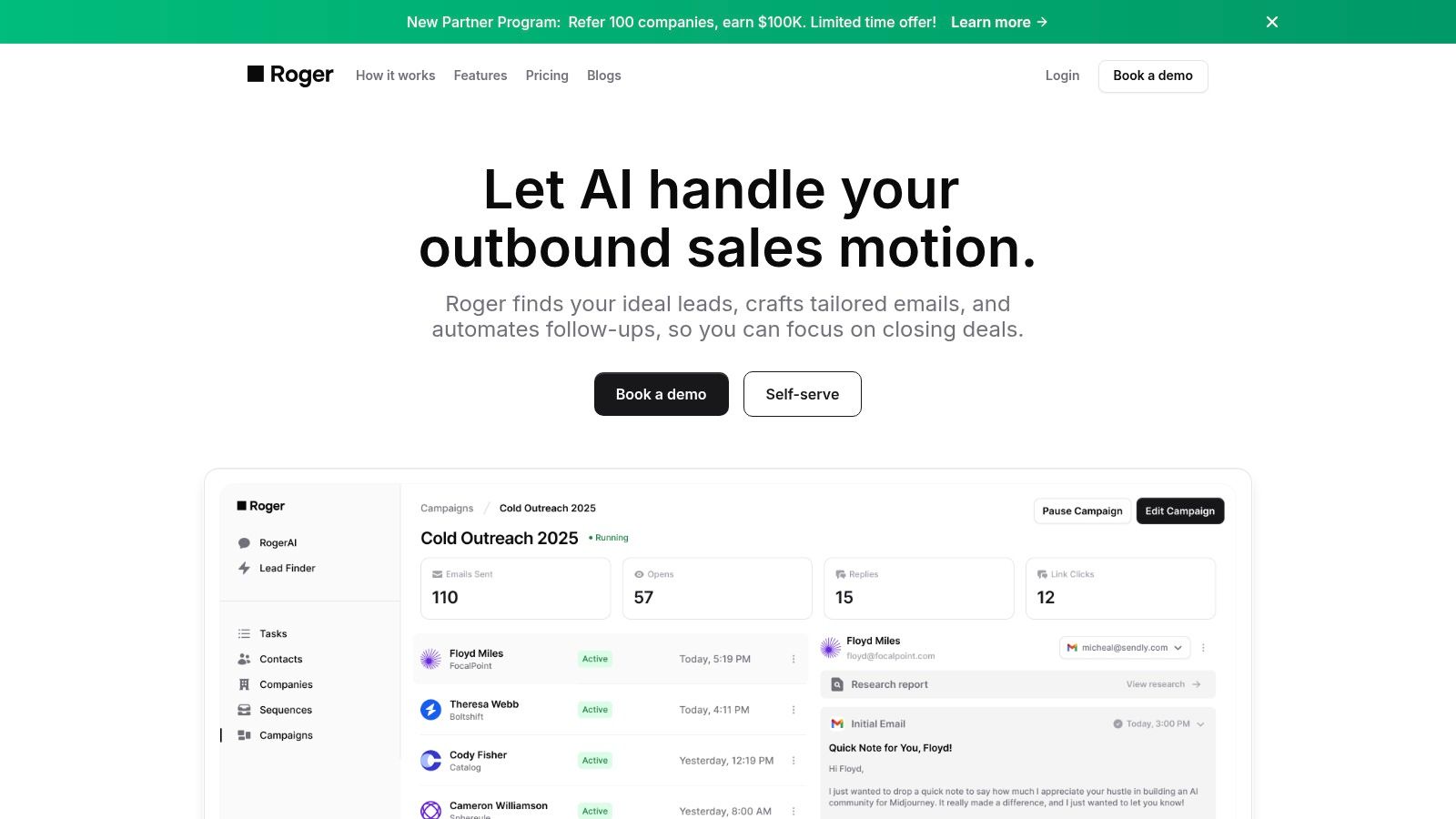
The platform’s core strength lies in its ability to deliver data-driven personalization at scale. Roger’s AI analyzes a prospect’s LinkedIn and Twitter activity to generate research-driven insights for each message. It also learns from your past email communications to mirror your unique tone, ensuring outreach feels authentic and consistent with your brand voice. This combination of autonomous execution and sophisticated personalization dramatically reduces the manual workload on sales teams, freeing them to focus exclusively on closing deals rather than sourcing them.
Key Features & Pricing
Roger’s features are designed to support scalable outbound operations for B2B teams. Daily reporting keeps teams aligned on performance, while premium tiers offer real-time Slack support, custom integrations, and dedicated assistance for more complex requirements.
| Feature Highlights | Basic | Standard | Premium | Enterprise |
|---|---|---|---|---|
| Price/Month | $800 | $2,000 | $3,000 | Custom |
| Leads Reached | 800 | 2,500 | 4,000 | Custom |
| Outreach Volume | 3.2k emails, 4k LinkedIn | 10k emails, 12.5k LinkedIn | 16k emails, 20k LinkedIn | Custom |
| Support | Standard | Standard | Real-time Slack | Dedicated |
| Sequences | Included | Included | Included | Unlimited |
| Analytics | Comprehensive | Comprehensive | Comprehensive | Comprehensive |
| Integrations | Standard | Standard | Standard | Custom |
Pros & Cons
- Pros:
- True End-to-End Automation: Handles lead discovery, verification, personalization, and multi-channel sequencing, significantly reducing manual SDR tasks.
- Data-Driven Personalization: Uses AI to research prospects and mirror your writing style for relevant, authentic outreach at scale.
- Clear, Scalable Tiers: Transparent pricing from startup to enterprise with concrete outreach volume limits.
- Enterprise-Ready: Offers unlimited sequences, custom integrations, and enhanced security for demanding teams.
- Cons:
- The entry-level price of $800/month may be a significant investment for very early-stage startups with minimal outbound needs.
- The website currently lacks public-facing case studies or customer testimonials, so prospective buyers should request performance data during the sales process.
Website: https://hireroger.com
2. Salesloft
Salesloft has solidified its position as one of the best sales engagement platforms by offering a comprehensive, enterprise-grade solution that covers the entire sales funnel. It excels in environments where robust governance, deep analytics, and seamless CRM integration are non-negotiable. Teams use Salesloft to execute sophisticated multichannel cadences, combining email, phone, and social touches into a unified workflow that keeps reps focused on high-value activities. Its bi-directional sync with Salesforce is particularly powerful, ensuring data integrity and providing a single source of truth for all engagement activities.
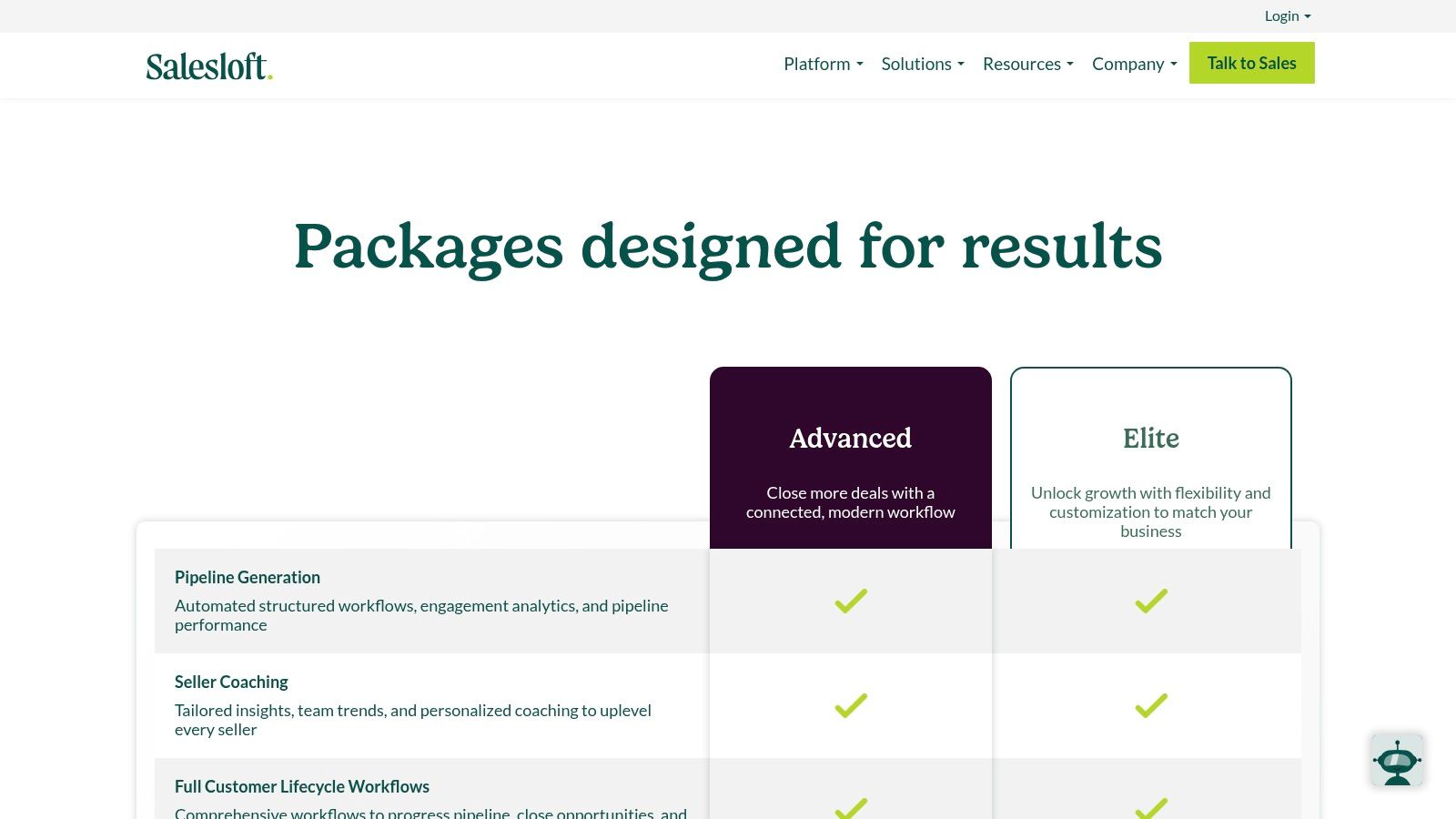
The platform stands out with its mature administrative controls and conversation intelligence features, making it ideal for larger teams needing to monitor performance, coach reps effectively, and maintain strict compliance standards. While its feature depth can be overkill for small startups, it's a top contender for established sales organizations.
Key Details & Use Cases
- Best For: Enterprise and mid-market sales teams requiring deep reporting, security, and administrative control.
- Key Feature: The combination of powerful Cadence automation with Conversation Intelligence provides a complete picture of rep activity and effectiveness.
- Pricing: Custom pricing based on team size and feature needs. You must contact their sales team for a quote, as packages (Prospect, Sell, Engage, Enterprise) are not itemized on their site.
- Implementation Tip: Leverage the platform's robust analytics from day one. Set up custom dashboards to track cadence performance, call outcomes, and email engagement to quickly identify what’s working and what isn't for your team.
| Pros | Cons |
|---|---|
| Deep enterprise capabilities and security | Pricing is not transparent; requires a sales call |
| Strong market reputation and user satisfaction | May be too complex or feature-heavy for smaller teams |
| Mature analytics for large-scale coaching | Longer implementation and adoption curve |
Website: https://www.salesloft.com/pricing
3. Outreach
Outreach has established itself as an enterprise-grade benchmark among the best sales engagement platforms, designed to optimize and automate the entire sales cycle. It excels in large-scale sales organizations where managing complex, multi-touch sequences across various channels is crucial for success. The platform’s core strength lies in its powerful workflow automation, enabling sales teams to execute and track emails, calls, social touches, and other tasks with precision, ensuring reps stay focused on revenue-generating activities. Its native integration with Salesforce is robust, creating a unified system for engagement and reporting.
The platform is distinguished by its comprehensive suite of tools, including conversation intelligence (Kaia) and advanced analytics, which provide deep insights into team performance and deal health. While its extensive feature set can present a steep learning curve for smaller businesses, it's an industry standard for enterprise B2B sales teams that need scale, control, and data-driven coaching capabilities to drive predictable pipeline.
Key Details & Use Cases
- Best For: Enterprise and large mid-market SDR and AE teams that require a comprehensive, all-in-one platform for sales execution, intelligence, and revenue operations.
- Key Feature: The combination of multichannel Sequences with AI-driven insights from its Conversation Intelligence add-on helps leaders coach reps effectively and identify deal risks.
- Pricing: Quote-based and not publicly listed. Pricing is customized based on team size, required features, and contract length, typically requiring an annual commitment.
- Implementation Tip: Dedicate resources to initial setup and training. Focus on building a few core, high-impact sequences first and use the platform’s A/B testing to refine messaging before rolling out more complex workflows.
| Pros | Cons |
|---|---|
| Very broad, enterprise-oriented feature set | No published pricing; quote-based via annual contracts |
| Extensive ecosystem and deep integrations | Can be complex to implement and manage for smaller teams |
| Strong reputation as an industry leader | Feature depth may be overwhelming if not fully utilized |
Website: https://www.outreach.io
4. Apollo.io
Apollo.io has carved out a unique space among the best sales engagement platforms by bundling a massive B2B contact database directly with its engagement tools. This all-in-one approach makes it incredibly attractive for SMBs and mid-market teams looking to build their outbound pipeline without subscribing to separate data and outreach solutions. Users can find prospects, enroll them in multi-step sequences combining email, calls, and LinkedIn tasks, and track all activity within a single, unified interface. The platform's self-serve model, including a free-forever plan, lowers the barrier to entry significantly.
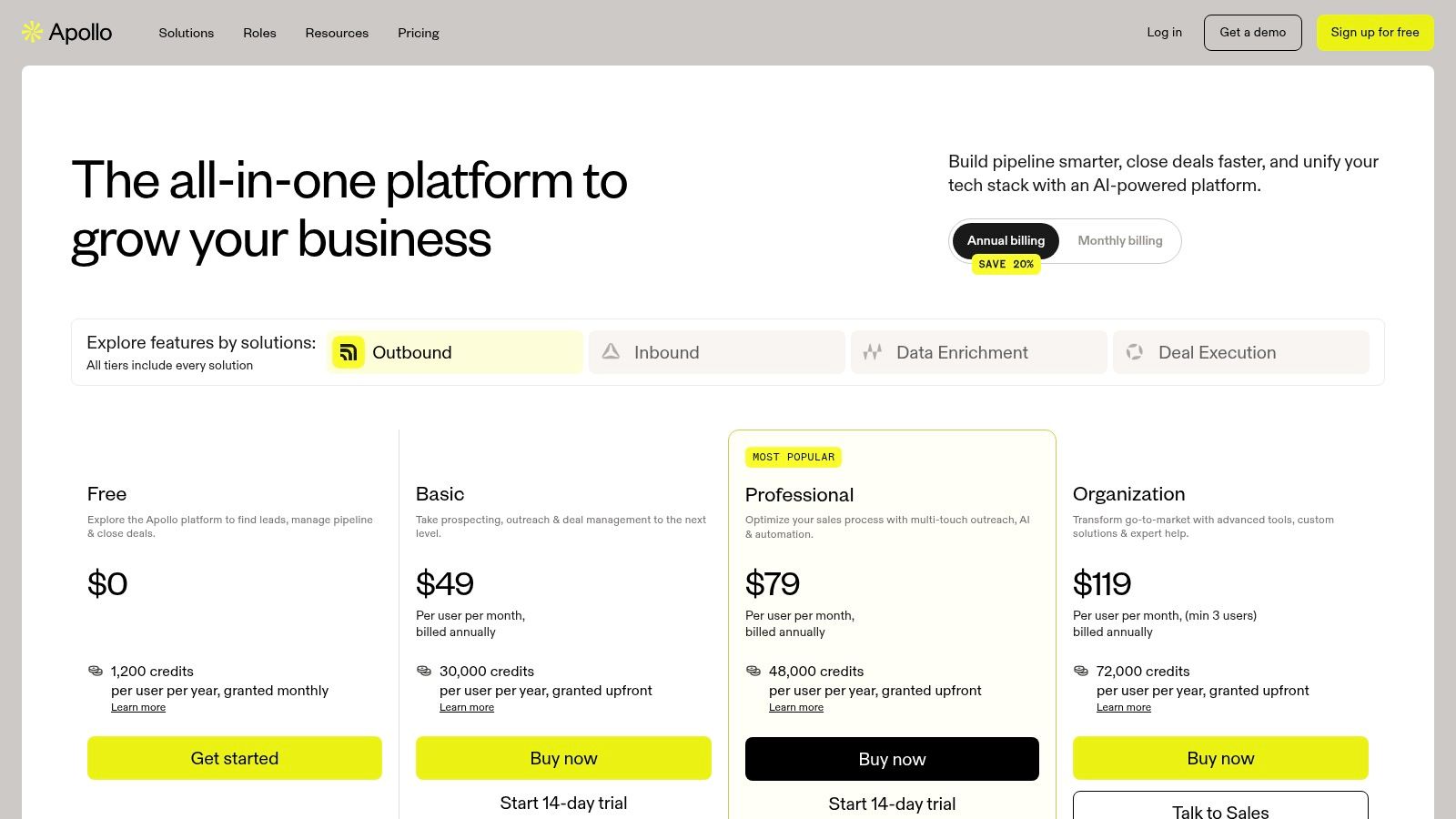
Its key differentiator is the tight integration between its data and sequencing engine, allowing teams to go from prospecting to outreach in minutes. While its enterprise features are still maturing compared to more established players, its value proposition for teams needing both data and engagement is hard to beat. For those considering Apollo.io as a sales engagement solution, comparing it with dedicated lead generation tools in articles like this one on ProfileSpider vs Apollo can provide further insights into its full capabilities.
Key Details & Use Cases
- Best For: SMBs and mid-market companies needing a cost-effective, all-in-one solution for B2B data and sales outreach.
- Key Feature: The integrated B2B database with over 275 million contacts combined with multi-channel sequencing (email, phone, LinkedIn).
- Pricing: Offers a free plan with limited credits. Paid plans start at $49/user/month (billed annually) for Basic, with Professional and Custom tiers available.
- Implementation Tip: Start by using the built-in email deliverability tools, such as the email warm-up and spam-testing features, to ensure your domain health is strong before launching large-scale sequences.
| Pros | Cons |
|---|---|
| Bundled data and engagement offers excellent value | Credit systems and add-ons can add complexity to billing |
| Self-serve sign-up and a free plan to test the platform | Advanced integrations and API access are reserved for high tiers |
| Strong focus on email deliverability and analytics | Data quality can sometimes be inconsistent for niche industries |
Website: https://www.apollo.io/pricing
5. HubSpot Sales Hub
HubSpot Sales Hub secures its spot as one of the best sales engagement platforms by offering a powerful, all-in-one solution built directly into its world-class CRM. It is the go-to choice for teams already invested in the HubSpot ecosystem or those seeking a unified platform that combines marketing, sales, and service without complex integrations. Sales Hub empowers reps with tools like automated email sequences, a meeting scheduler, and built-in calling, all designed to streamline outreach and eliminate tedious administrative tasks. Its native connection to the HubSpot CRM ensures every interaction is logged automatically, providing a complete view of the customer journey.
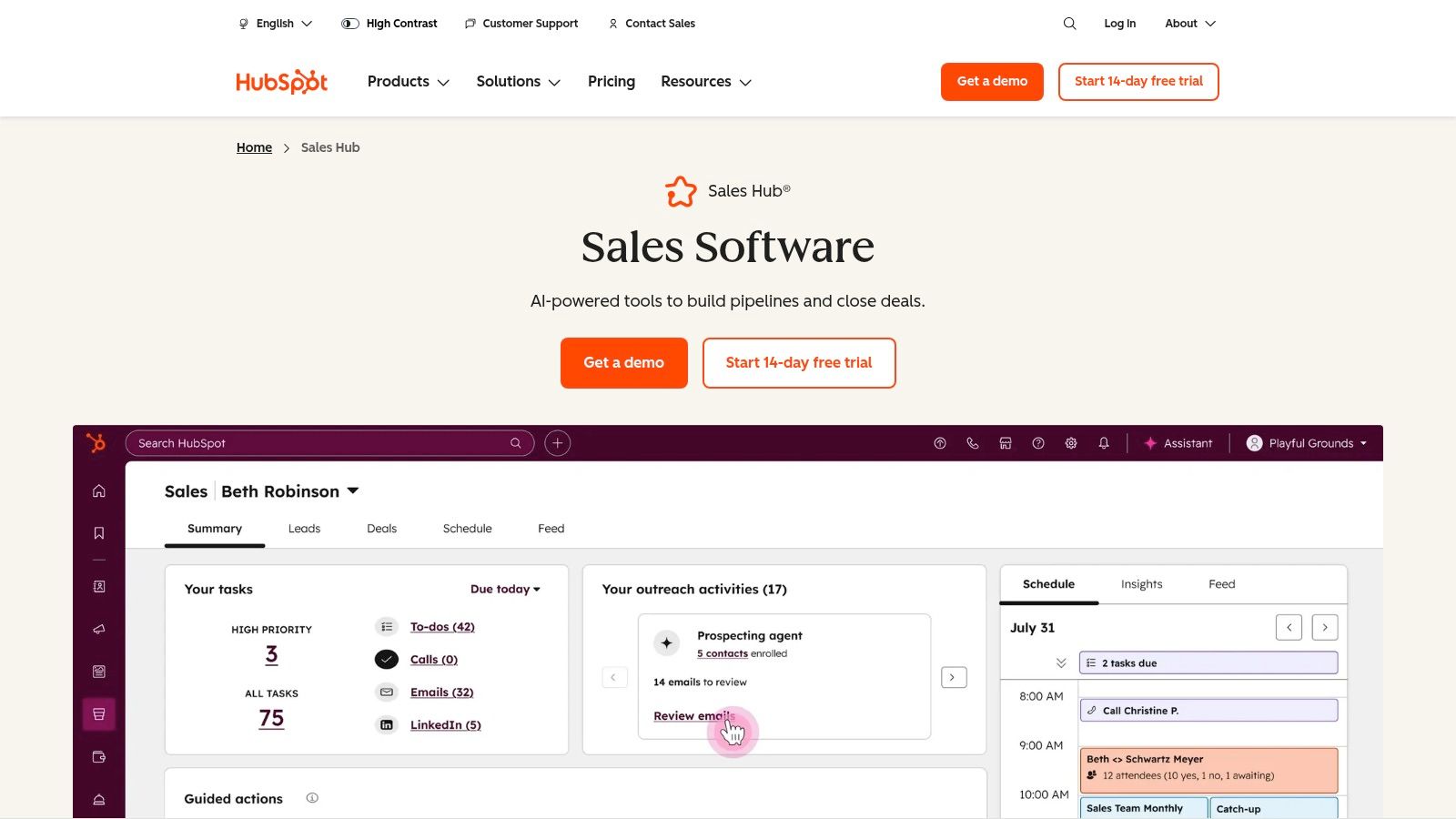
The platform's strength lies in its user-friendliness and transparent, seat-based pricing, which makes it highly accessible for small to mid-sized businesses. For a deeper dive into one of the leading platforms, explore a comprehensive guide to HubSpot Sales Hub and its features for B2B growth. While some advanced features are reserved for higher tiers, its ease of adoption and seamless data flow make it a top contender for growing teams focused on efficiency.
Key Details & Use Cases
- Best For: SMBs and mid-market companies that use or plan to use the HubSpot CRM and want a tightly integrated sales engagement solution.
- Key Feature: The native integration between Sequences, Meetings, and the CRM provides a seamless workflow for reps without toggling between multiple applications.
- Pricing: Offers a free tier with limited features. Paid plans start at $15/user/month for Starter, $90/user/month for Professional, and $150/user/month for Enterprise (billed annually). Onboarding fees apply to higher tiers.
- Implementation Tip: Start by building a few core email sequences based on your most successful templates. Use the built-in reporting to A/B test subject lines and call-to-action effectiveness to quickly optimize your outreach.
| Pros | Cons |
|---|---|
| Seamless integration with HubSpot's CRM | Onboarding fee required for Professional & Enterprise tiers |
| Clear, transparent seat-based pricing tiers | Best features are gated in more expensive plans |
| Easy for new reps to learn and adopt quickly | Less standalone power if not using the full HubSpot suite |
Website: https://www.hubspot.com/products/sales
6. Salesforce Sales Engagement (Sales Cloud add-on)
For organizations deeply embedded in the Salesforce ecosystem, Salesforce Sales Engagement offers an unparalleled native experience. As an add-on to Sales Cloud, it eliminates the data sync issues and integration complexities that can plague third-party tools. Reps can execute multi-step cadences, manage their tasks in a prioritized Work Queue, and leverage Einstein AI for conversation insights and activity capture directly within the CRM they already use, ensuring a single source of truth for all sales activities and reporting.
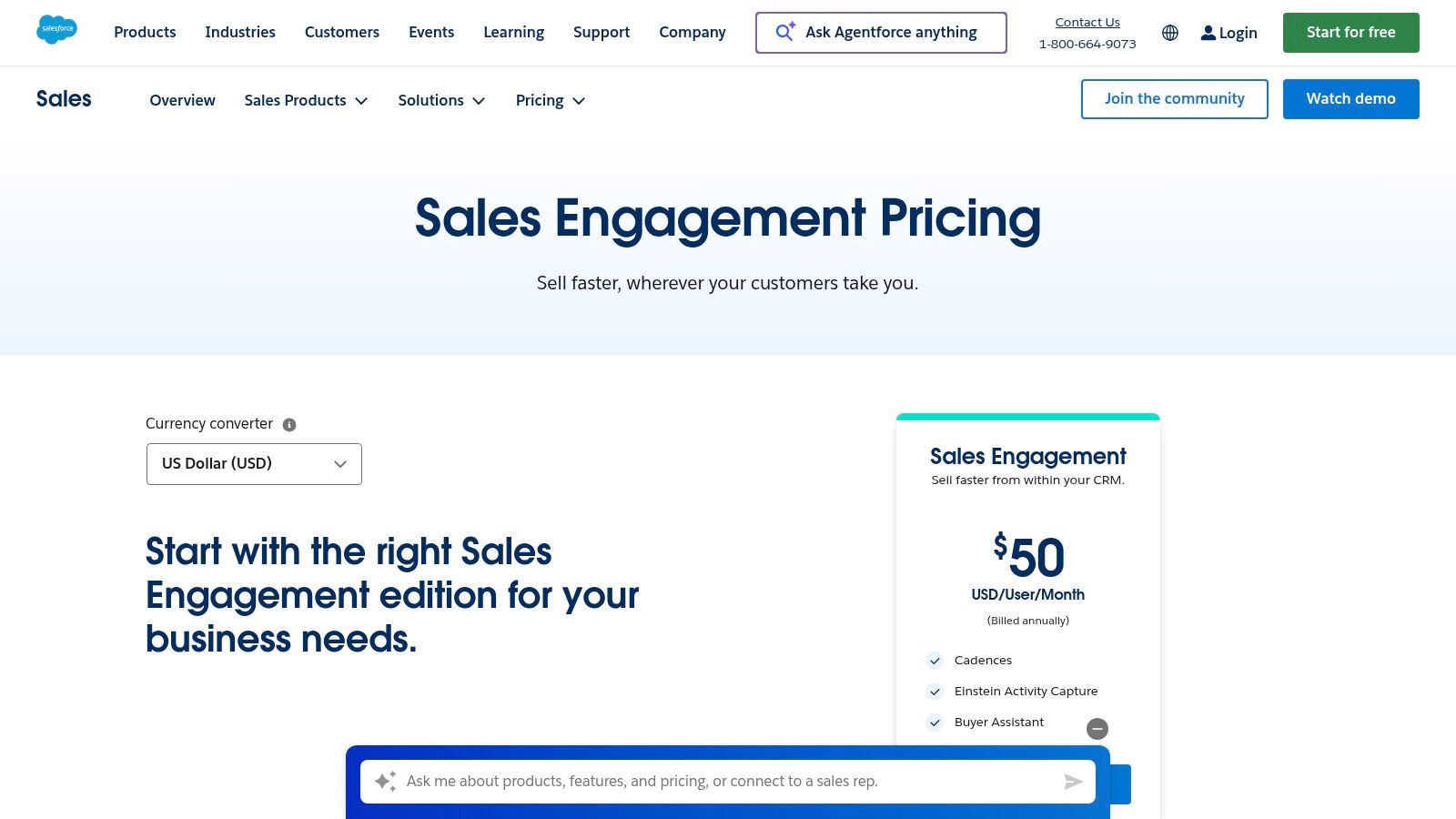
This platform is the logical choice for teams that prioritize data integrity, security, and unified reporting above all else. Because it's built on the Salesforce platform, administrators can leverage familiar tools to customize workflows and build dashboards. While its feature set may not be as expansive as standalone competitors, its seamless integration makes it one of the best sales engagement platforms for any Salesforce-centric organization.
Key Details & Use Cases
- Best For: Companies standardized on Salesforce who need a native engagement solution to maintain data integrity and simplify their tech stack.
- Key Feature: The native Work Queue, which guides reps through their daily tasks across email, calls, and other steps defined in their cadences, all within the Sales Cloud interface.
- Pricing: Available as an add-on for Sales Cloud Unlimited+ Edition or as a paid add-on for Enterprise and Performance Editions. Specific pricing requires a conversation with a Salesforce account executive.
- Implementation Tip: Work closely with your Salesforce admin to properly configure Cadences and Work Queues. Ensure that page layouts are optimized to display engagement components, preventing reps from having to navigate away from their lead or contact records.
| Pros | Cons |
|---|---|
| Perfect, seamless integration with Salesforce CRM | Only available for Salesforce customers; not a standalone tool |
| Eliminates data sync errors and provides unified reporting | Feature depth and capabilities are tied to Salesforce edition |
| Leverages existing Salesforce security and admin controls | Implementation can be complex to fully realize its value |
Website: https://www.salesforce.com/sales/engagement-platform/pricing/
7. Groove by Clari
Groove, now part of Clari's revenue platform, carves out its niche as one of the best sales engagement platforms specifically for organizations deeply embedded in the Salesforce ecosystem. Its key differentiator is being the only Salesforce-native platform, which eliminates sync errors and provides unparalleled data integrity by logging all activities directly within Salesforce. This makes it a go-to for revenue teams that prioritize a single source of truth and need engagement data to flow seamlessly into forecasting and pipeline management.
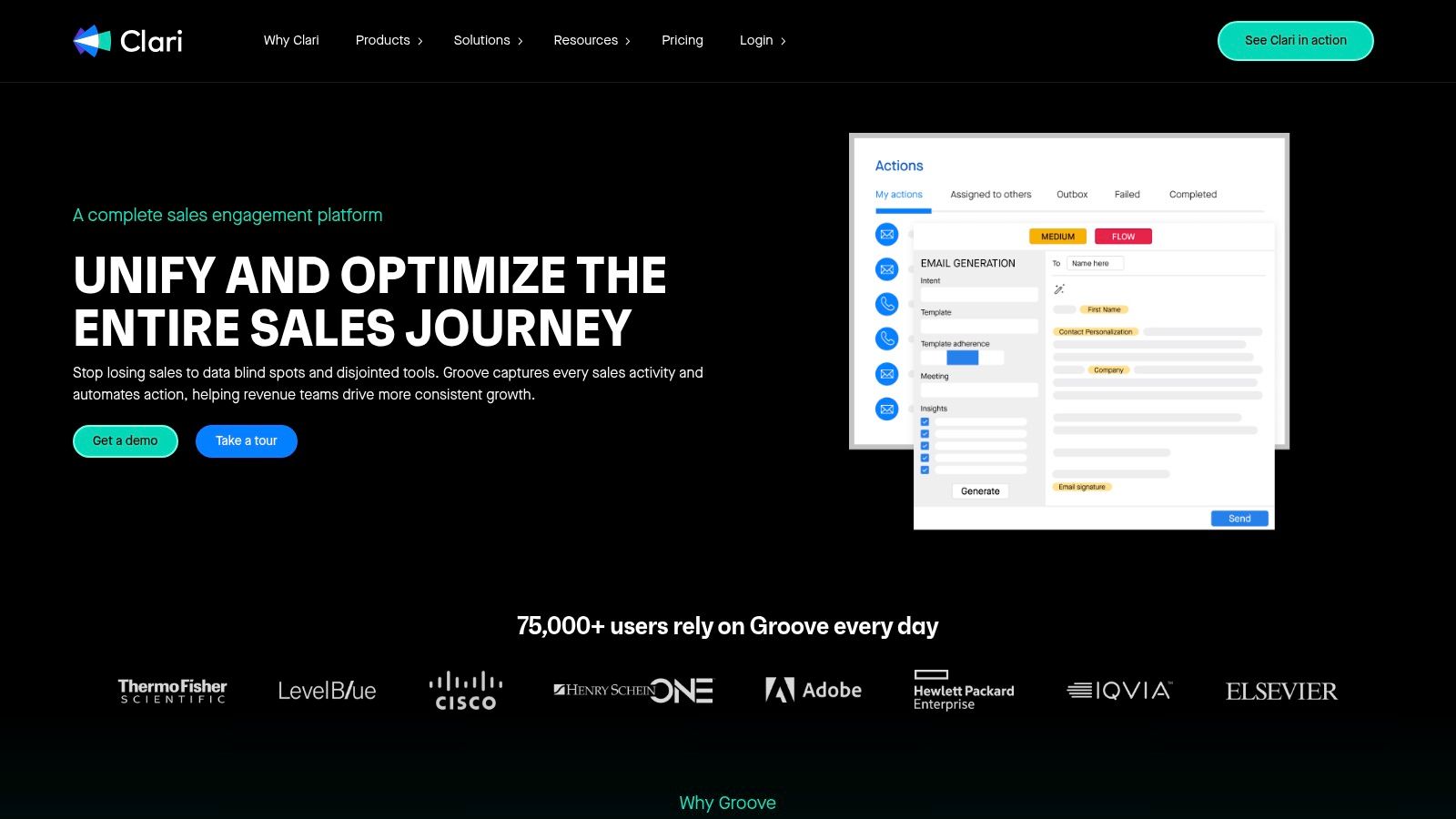
The integration with Clari’s broader RevOps capabilities means Groove's playbooks and AI assistants are not just about activity volume but are tied directly to revenue workflows and pipeline execution. It is designed for enterprise-scale governance, offering robust administrative controls that appeal to large, security-conscious sales teams. While its dependency on Salesforce might deter some, for Salesforce-centric companies, Groove offers a level of integration and data accuracy that other platforms struggle to match.
Key Details & Use Cases
- Best For: Enterprise and mid-market companies that run their entire revenue operation on Salesforce and require a deeply integrated, compliant engagement solution.
- Key Feature: Its Salesforce-native architecture ensures 100% accurate activity capture and eliminates data sync issues, providing a reliable foundation for revenue intelligence.
- Pricing: Pricing is not publicly available. You must request a demo and receive a custom quote tailored to your organization's specific needs.
- Implementation Tip: Work closely with your Salesforce admin during setup to customize Groove's activity logging fields. This ensures the engagement data captured aligns perfectly with your existing Salesforce reporting structure and custom objects from day one.
| Pros | Cons |
|---|---|
| Unmatched Salesforce alignment and data integrity | Pricing is not transparent; requires a demo and quote |
| Strong enterprise governance and admin features | Primarily tailored for Salesforce environments |
| Aligns engagement activity with revenue workflows | May lack flexibility for non-Salesforce CRM users |
Website: https://www.clari.com/products/groove/
8. Mailshake
Mailshake has earned its spot as one of the best sales engagement platforms by focusing intently on making cold outreach simple, scalable, and effective. It’s built for sales teams and founders who prioritize generating leads through automated email sequences, supplemented by phone and social touches. The platform excels at managing high-volume outbound campaigns with an emphasis on email deliverability, offering built-in tools like an email warm-up service, list verification, and sender rotation to ensure messages land in the primary inbox.
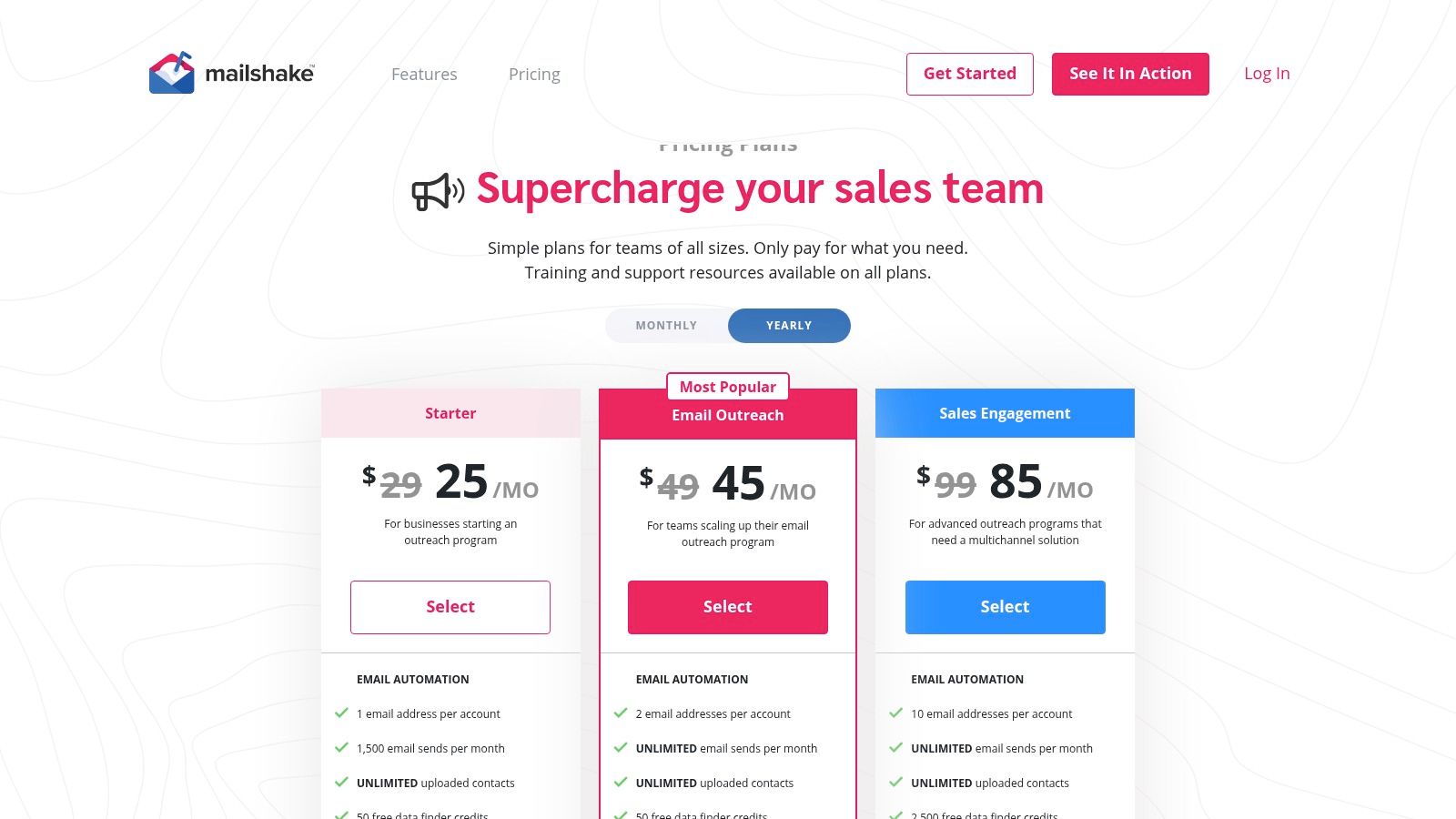
Its standout quality is its straightforward, no-nonsense approach. While some enterprise tools have a steep learning curve, Mailshake is accessible and can be deployed quickly. This makes it a go-to choice for teams that need to launch outbound motions without a lengthy implementation process, combining email, a built-in phone dialer, and LinkedIn automation into a cohesive, easy-to-manage workflow.
Key Details & Use Cases
- Best For: Startups, SMBs, and agencies focused on building a scalable cold outbound pipeline.
- Key Feature: Comprehensive email deliverability suite, including an AI-powered warm-up tool and automated sender rotation to protect domain reputation.
- Pricing: Transparent pricing is a major advantage. Plans start at $58/user/month for Email Outreach and $83/user/month for Sales Engagement, which includes the dialer and social selling features.
- Implementation Tip: Use the integrated "Lead Catcher" to automatically route and manage interested replies. Set up rules to pause sequences for positive responses, preventing awkward follow-ups and keeping your team focused on warm leads.
| Pros | Cons |
|---|---|
| Transparent, user-based pricing plans | Lower-tier plans have limitations on sends and features |
| Strong focus on email deliverability tools | Integrations are less deep than enterprise-grade platforms |
| Simple, user-friendly interface for fast setup | Primarily built for a top-of-funnel, outbound sales motion |
Website: https://mailshake.com/pricing
9. Yesware
Yesware carves out its niche as one of the best sales engagement platforms by focusing on simplicity and inbox-centric workflows. It integrates directly into Gmail and Outlook, providing sellers with essential tools like email tracking, templates, and automated sequences (Campaigns) without forcing them to leave their primary workspace. This approach dramatically reduces the learning curve and boosts adoption rates, making it an excellent choice for teams that want to enhance their email outreach without committing to a complex, standalone system.
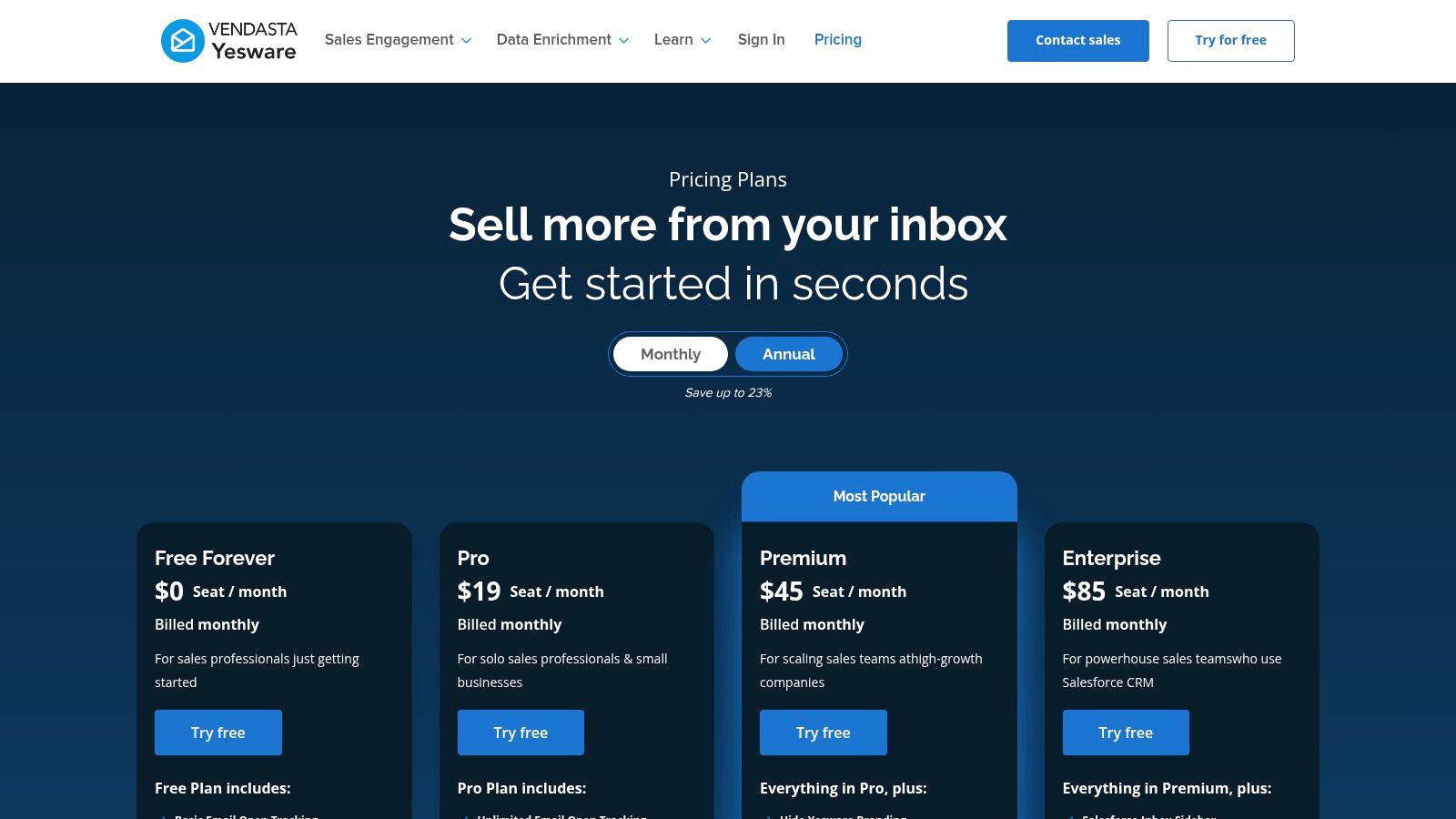
The platform is particularly effective for individual reps or smaller teams prioritizing high-volume, personalized email prospecting. While it lacks the deep, multichannel capabilities of enterprise-grade solutions, its straightforward functionality and affordable entry points offer a powerful way to bring structure and data to the sales process. Its direct Salesforce sync on higher tiers ensures that critical engagement data is captured in the CRM.
Key Details & Use Cases
- Best For: Individuals and SMBs looking for an easy-to-use, inbox-based tool to track and automate email outreach.
- Key Feature: The seamless integration into Gmail and Outlook, which allows reps to access tracking, templates, and campaigns directly from their email composer.
- Pricing: Offers a free-forever plan with basic tracking. Paid plans start at $15/user/month (Pro), with higher tiers like Premium ($35) and Enterprise ($65) adding features like Campaigns and Salesforce sync.
- Implementation Tip: Start by converting your team's most successful one-off emails into templates within Yesware. This provides immediate value and encourages reps to use the platform for all their outreach, which then feeds performance data into the reporting dashboards.
| Pros | Cons |
|---|---|
| Extremely fast to adopt for inbox-centric sellers | Lacks the deep multichannel features of other platforms |
| Free-forever and low-cost entry plans available | Advanced reporting and CRM sync are limited to higher tiers |
| Simple, intuitive user interface | Mobile app has significant limitations |
Website: https://www.yesware.com/plans-and-pricing
10. Mixmax
Mixmax positions itself as one of the best sales engagement platforms for teams deeply integrated with Google Workspace. It transforms the Gmail inbox into a powerful sales hub, layering on sequences, calendar scheduling, and in-email interactive elements that streamline workflows without forcing reps to switch contexts. Its strength lies in its intuitive, Gmail-native experience, making it incredibly fast for Google-centric teams to adopt and start executing multichannel outreach campaigns.
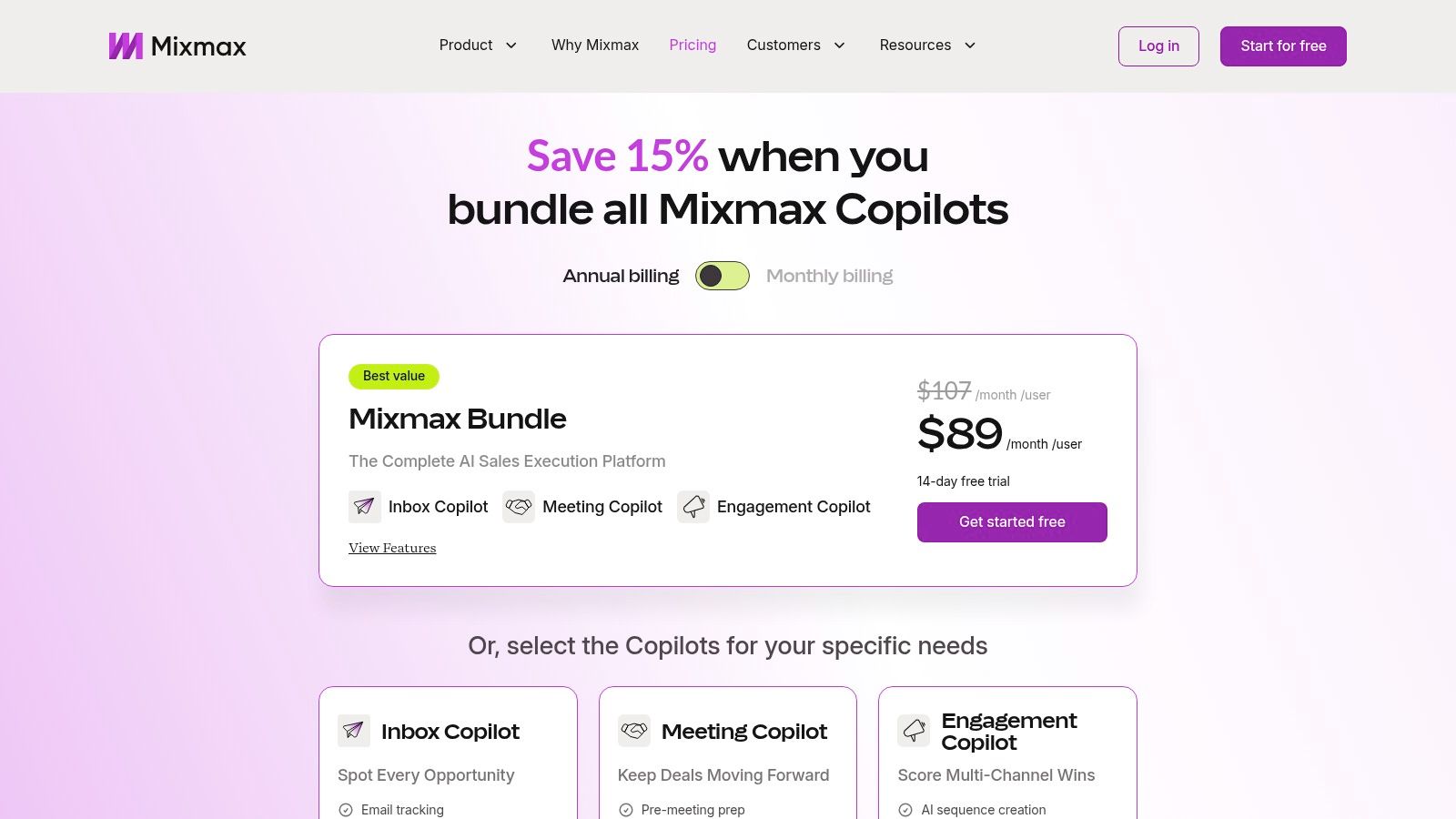
The platform stands out by bundling its features into role-oriented "Copilot" packages (Inbox, Meeting, Engagement), which helps tailor the toolset to specific user needs. The ability to use rules and triggers for advanced automation directly within the inbox is a significant advantage, allowing reps to automate follow-ups and data entry based on prospect actions, saving valuable time.
Key Details & Use Cases
- Best For: Sales teams and individuals who live in Gmail and need a seamless way to add engagement, scheduling, and automation to their existing workflow.
- Key Feature: The in-email interactive elements, such as polls and surveys, combined with powerful calendar scheduling directly within the compose window, increase engagement rates.
- Pricing: Offers a free plan for basic tracking. Paid plans start at $29/user/month (Growth) and go up to $69/user/month (Enterprise). A dialer is available as an add-on.
- Implementation Tip: Start by implementing the calendar scheduling and meeting templates. This provides an immediate ROI by reducing the back-and-forth of booking calls and creates a consistent, professional brand experience.
| Pros | Cons |
|---|---|
| Seamless integration for Google Workspace/Gmail users | Best experience is Gmail-centric; not ideal for other clients |
| Clear plan differentiation and a budget-friendly bundle | Dialer and some advanced branding features are add-ons |
| Powerful in-email automation with rules and triggers | Less comprehensive than enterprise-focused standalone platforms |
Website: https://www.mixmax.com/pricing
11. Reply.io
Reply.io has carved out a strong niche as one of the best sales engagement platforms for teams that prioritize multichannel outreach and transparent, scalable pricing. It enables users to build and automate sequences across email, LinkedIn, calls, SMS, and even WhatsApp, centralizing outreach in a single workflow. A key differentiator is its focus on deliverability, offering an integrated email warm-up tool and validation features to ensure messages land in the inbox, not the spam folder.
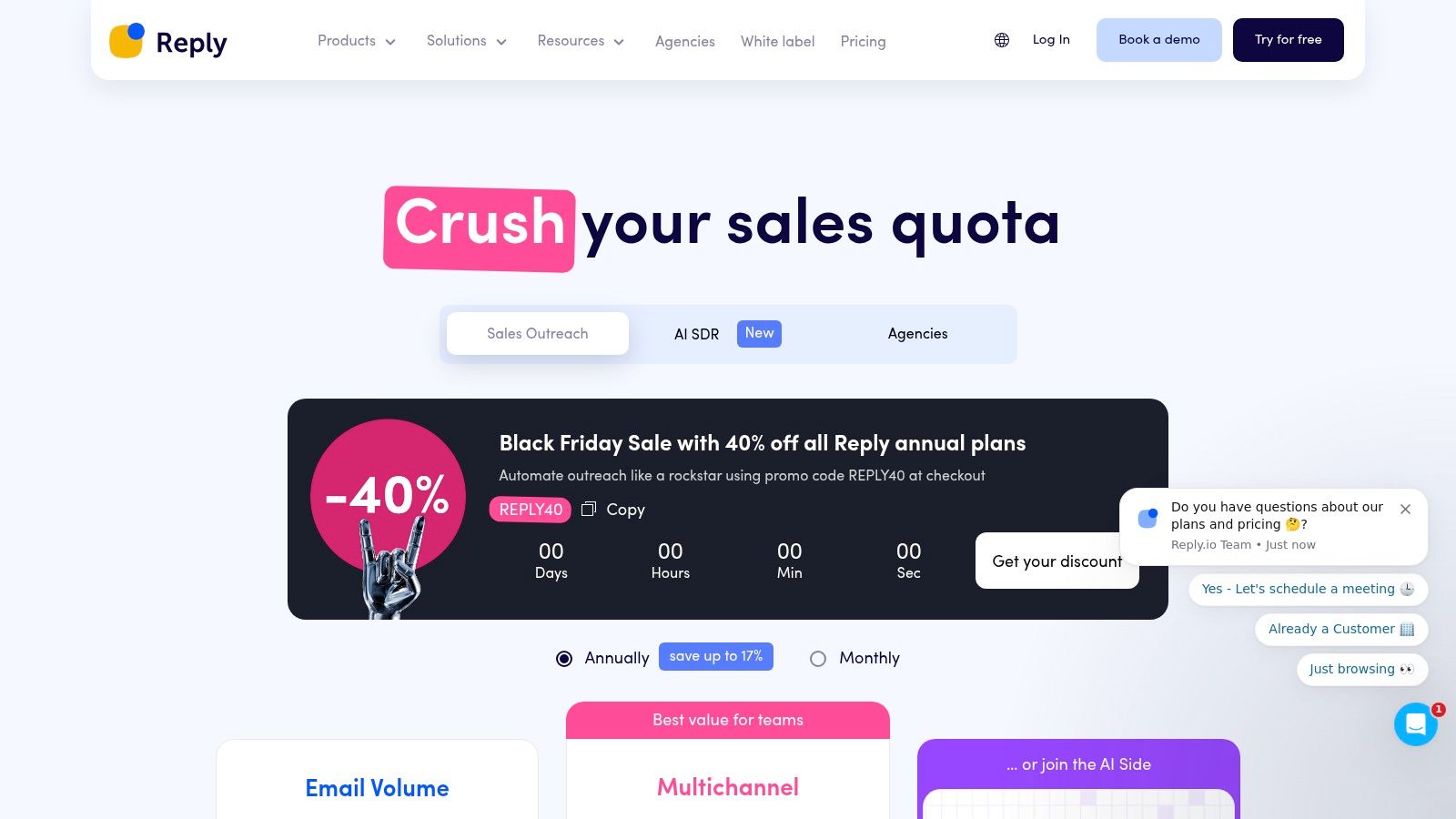
The platform is particularly well-suited for growing teams and agencies due to its multi-workspace support and granular pricing model that scales with outreach volume. With its emerging AI SDR capabilities, Reply.io is also positioning itself as a solution for teams looking to augment their prospecting efforts with artificial intelligence, making it a flexible choice for modern sales organizations.
Key Details & Use Cases
- Best For: Startups, SMBs, and agencies needing a flexible, multichannel platform with predictable pricing based on usage.
- Key Feature: The combination of a comprehensive multichannel sequence builder with a built-in email deliverability suite and warm-up tool.
- Pricing: Offers transparent, user-based plans starting from $60/month, with different tiers for outreach volume. Some features like LinkedIn automation and calling are add-ons.
- Implementation Tip: Take full advantage of the unlimited email warm-up feature before launching any large-scale campaigns. Connect your sending accounts early to build a strong sender reputation and maximize your deliverability from day one.
| Pros | Cons |
|---|---|
| Transparent, granular pricing by outreach volume and channels | LinkedIn and calling are often priced as add-ons on lower tiers |
| Excellent for agencies with multi-workspace support | The detailed feature matrix can feel complex at first |
| Integrated deliverability suite and email warm-up tool | User interface can have a steeper learning curve than simpler tools |
Website: https://reply.io/pricing/
12. G2 (Sales Engagement Software category)
While not a sales engagement platform itself, G2's dedicated category is an indispensable research tool for any team evaluating their options. It functions as a meta-resource, aggregating verified user reviews, detailed feature comparisons, and real-time market-presence data. Sales leaders use G2 to create an initial shortlist of the best sales engagement platforms by filtering vendors based on company size, user satisfaction scores, and specific features, ensuring the tools they evaluate are a good fit from the start. The platform's Grid Reports provide a powerful visual representation of which tools are leaders versus niche players.
G2’s value lies in its crowdsourced insights, which help cut through marketing jargon to reveal how platforms actually perform in real-world scenarios. By comparing tools side-by-side and reading reviews from peers, buyers can make a more informed decision and avoid costly mistakes.
Key Details & Use Cases
- Best For: Sales leaders and RevOps professionals in the initial research and vendor shortlisting phase of their buying process.
- Key Feature: The interactive Grid® for Sales Engagement, which plots platforms based on user satisfaction and market presence, filterable by market segment (Small Business, Mid-Market, Enterprise).
- Pricing: Free to access and browse all reviews and reports.
- Implementation Tip: Don't just look at the overall score. Dive into the most recent reviews and filter them by company size and role to find feedback that is most relevant to your specific situation and use case. Pay attention to comments on implementation and support.
| Pros | Cons |
|---|---|
| Excellent for creating a data-backed vendor shortlist | Be mindful of sponsored placements that appear at the top of lists |
| Access to hundreds of verified, real-user reviews | Review volume and recency can vary significantly between platforms |
| Filterable grids for specific segments (SMB vs. Enterprise) | Vendor-provided details should always be cross-checked on their sites |
Website: https://www.g2.com/categories/sales-engagement
Top 12 Sales Engagement Platforms Comparison
| Product | Core features | Quality (★) | Price / Value (💰) | Audience (👥) | Unique strengths (✨) |
|---|---|---|---|---|---|
| Roger 🏆 | AI lead discovery, verify/enrich, personalized email + LinkedIn sequences, meeting booking, analytics | ★★★★☆ | 💰 Basic $800 / Std $2k / Premium $3k / Enterprise (custom) | 👥 Startups, SMBs, agencies, revenue teams | ✨ End‑to‑end AI automation, mirrors your tone, per‑lead research, scalable plans |
| Salesloft | Multichannel cadences, integrated dialer, conversation intelligence, CRM sync | ★★★★★ | 💰 Quote-based (enterprise-focused) | 👥 Mid‑market → Enterprise sales orgs | ✨ Deep reporting, governance, mature admin tools |
| Outreach | Sequences, dialer & convo intel, Salesforce-native email, coaching & analytics | ★★★★★ | 💰 Quote-based (annual contracts) | 👥 Large SDR/AE organizations | ✨ Broad enterprise feature set, extensive integrations |
| Apollo.io | Large contact database + sequences, dialer, deliverability tools | ★★★★☆ | 💰 Self-serve tiers + free plan; add-ons | 👥 SMBs & mid‑market teams | ✨ Bundled data + engagement = strong value |
| HubSpot Sales Hub | CRM-native sequences, meeting scheduler, calling, forecasting | ★★★★☆ | 💰 Seat-based tiers; transparent; onboarding fees on higher tiers | 👥 HubSpot CRM users; SMB → Enterprise | ✨ Easy adoption, seamless HubSpot integration |
| Salesforce Sales Engagement | Salesforce-native cadences, Einstein insights, work queues, prospecting center | ★★★★★ | 💰 Add-on to Salesforce (depends on license) | 👥 Salesforce-centric organizations | ✨ Native data integrity & reporting |
| Groove (by Clari) | Salesforce-native activity capture, AI assistants, playbooks, pipeline alignment | ★★★★☆ | 💰 Quote-based | 👥 Enterprise Salesforce customers | ✨ Aligns engagement with revenue workflows |
| Mailshake | Cold email sequences, LinkedIn steps, dialer, deliverability & warm-up | ★★★★ | 💰 Transparent plans; upper tiers = unlimited sends | 👥 Outbound-focused teams & SMBs | ✨ Deliverability guidance, practical onboarding |
| Yesware | Inbox-centric tracking, templates, campaigns, meeting scheduler, Salesforce sync | ★★★★ | 💰 Free-forever + low-cost entry plans | 👥 Inbox-first sellers (Gmail/Outlook) | ✨ Fast adoption from the inbox; affordable entry |
| Mixmax | Gmail-first sequences, scheduling, in-email interactive elements, automation rules | ★★★★ | 💰 Clear bundles; dialer/add-ons | 👥 Google Workspace users | ✨ Advanced in-email automation & scheduling |
| Reply.io | Multichannel automation (email, LinkedIn, SMS, calls, WhatsApp), deliverability, AI SDR | ★★★★ | 💰 Volume/channel-based pricing; transparent tiers | 👥 Agencies, scaling teams, multi-workspace | ✨ Granular pricing, multi-channel breadth, AI SDR option |
| G2 (Category) | Filterable category pages, side‑by‑side comparisons, verified user reviews, Grid reports | ★★★★ | 💰 Free to browse; vendor packages vary | 👥 Buyers shortlisting vendors | ✨ Verified reviews & comparative grids for vendor selection |
Final Thoughts
Navigating the crowded market of sales engagement platforms can feel overwhelming, but making an informed decision is the cornerstone of building a high-performing sales engine. Throughout this guide, we've dissected the industry's top contenders, moving beyond surface-level features to uncover the specific use cases, integration capabilities, and ideal buyer profiles for each. The journey from manual, disjointed outreach to automated, intelligent engagement is transformative, and the right platform is your vehicle for that journey.
The key takeaway is that there is no single "best" sales engagement platform for everyone. The ideal choice is deeply contextual, hinging entirely on your team's size, existing tech stack, budget, and strategic goals. A lean startup's need for an all-in-one, cost-effective solution like Apollo.io or Mailshake contrasts sharply with an enterprise's demand for the robust analytics, governance, and deep CRM integration offered by Salesloft or Outreach.
Recapping the Key Decision Factors
As you finalize your evaluation, circle back to the core principles we've discussed. Your decision should be a balanced assessment of several critical factors, not just a flashy feature set.
- Integration is Non-Negotiable: Your chosen platform must seamlessly sync with your CRM. Poor integration leads to data silos, frustrated reps, and inaccurate reporting, completely undermining the purpose of the tool. Evaluate the depth of integration, not just the presence of a logo on their website.
- Scalability Defines Future Success: Consider where your team will be in 12 to 24 months. A platform that's perfect today might become a bottleneck tomorrow. Look for solutions with flexible pricing tiers, robust API access, and the ability to support growing teams with features like advanced permissions and team-based analytics.
- Adoption Determines ROI: The most powerful platform is useless if your team doesn't use it. Prioritize user experience (UX), intuitive design, and the quality of the provider's onboarding and support. A platform with a steep learning curve can lead to low adoption and a failed investment.
Your Actionable Path Forward
Choosing from the best sales engagement platforms is a strategic process, not a simple purchase. Before you sign a contract, ensure you have a clear plan.
- Define Your "Must-Haves": Use the evaluation checklist from earlier in this article to create a shortlist. What are the absolute deal-breakers for your team? Is it native Salesforce integration, advanced A/B testing, or a built-in dialer?
- Run Pilot Programs: Never commit to a long-term contract without a trial. Select two or three top contenders and have a small group of reps run a pilot program. Gather real-world feedback on usability, effectiveness, and any friction points.
- Plan for Implementation: A successful rollout requires more than just sending out login credentials. Develop a clear implementation plan that includes data migration, team training, and defining your initial sales cadences and content. A well-managed launch is critical for driving immediate adoption and value.
Ultimately, the goal of a sales engagement platform is to empower your reps to build more meaningful connections at scale. It’s about replacing repetitive administrative tasks with strategic, data-driven conversations. By carefully weighing your unique needs against the strengths and weaknesses of each solution, you can select a tool that not only streamlines your workflow but becomes a true catalyst for revenue growth.
Ready to bypass the complexity of managing software and focus directly on results? If you need to build a high-quality pipeline without the overhead of hiring and training an in-house SDR team, Roger offers a powerful alternative. We combine expert human talent with our proprietary technology to deliver qualified meetings directly to your calendar, so you can focus on what you do best: closing deals. Learn more about how Roger can accelerate your growth.